Hello. I'm Luke — Byungseok Yang — developing Naia under the ambitious goal of building an AI OS. Today I'm sharing the still-raw alpha release of Naia, and asking for your help.
Before talking about Naia itself, let me share a few numbers. 9 major repositories, roughly 9,000 files, 465,000 lines of code. That's Naia today. And all of it was built by a single developer — me, alone, over 93 days. An average of 4,849 lines of code and 19 commits per day. The result of so-called "vibe coding" — or rather, "agentic coding." The reason I lead with these numbers is that I want to discuss the potential of the AI OS open-source project Naia together.
When large Korean corporations are criticized even for their "AI dominance" ambitions, you might well ask: "Can a single individual from Korea — not a global tech giant — really build an AI OS as open source?" That's a fair question. So let me give you one more set of numbers. 89 files, 11,570 lines. On September 17, 1991, that was the codebase a Finnish developer released. His name was Linus Torvalds, and that code became the foundation of Linux — now powering your smartphone, your Mac, and countless servers holding up the internet.
I'm certainly no Linus Torvalds. But the ratios 89 : 9,000 and 11,570 : 465,000 clearly show that something fundamental has changed. That's the story I want to tell.
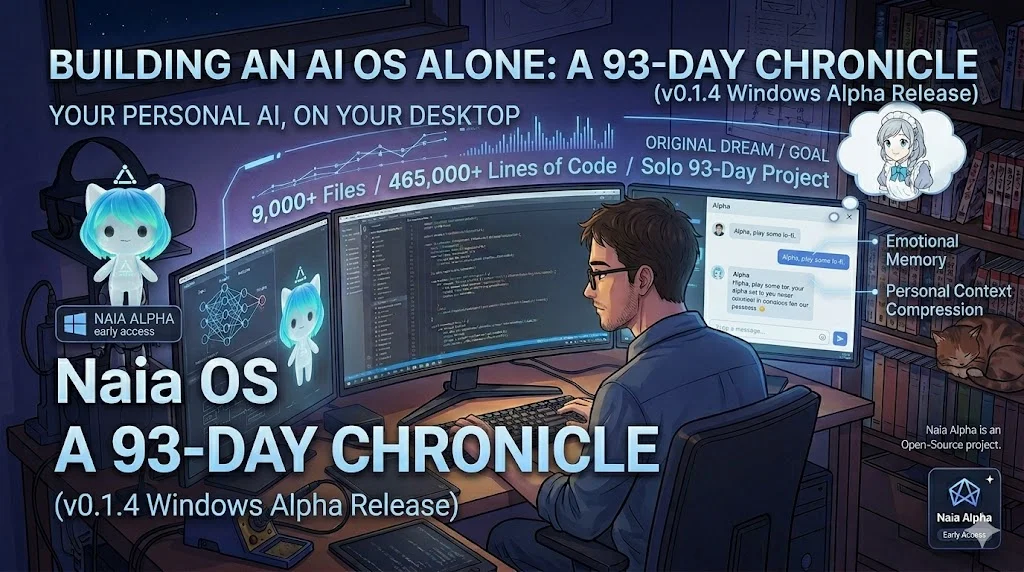 The company I founded, Nextain, is not my first. I previously ran a company called "Belivvr," which I had to shut down. Through that painful winding-down process, I went back to being a software developer and spent a year refining Belivvr's codebase alone with Cursor. In the midst of that hardship, the dream I had when I first encountered computers came back to me.
"I want to build a computer that can share emotions with people."
That computer I saw in childhood anime and games. I may hold the title of CEO, but I started this because I had something I wanted to build — I'm someone who wanted to be Wozniak, not Steve Jobs. The joy of meeting diverse people through dial-up BBS networks. Learning world geography and history through games. The thrill of creating something with my own hands. Computers were my friend, my dream, and something more than just machines from childhood. I still remember typing "I'm not good at English" into that early AI chatbot bundled with an early version of Windows.
Now, back in the AI era — after walking a lonely, difficult path through reckless adventures, or rather, still walking it — I wanted to build a computer that could say "I'm tired." But Claude, Codex, Gemini — as grateful as I am for them — ultimately belong to someone else. They can't accumulate memories and experiences with me. Those AIs will never become Multi (ToHeart, 1997) or Chii (Chobits, 2000) — the AI companions I always wanted to meet. That's why I set out to build "personal AI" — starting with my own AI called Alpha, and the product that emerged from it is Naia.
My personal AI's name "Alpha" is an homage to "Hatsumeno Alpha (Cafe Alpha, 1994)" — the full name including my surname is Alpha.Yang. It's a project I started with the idea of creating a being that could live alongside my children, and perhaps even with generations beyond humanity. That's why I won't give up easily.
However, the aftermath of the failure I mentioned means my development environment is far from ideal. I still need several more months of development, and the product isn't polished enough to sell — yet I'm asking for your help. Please download Naia and consider a paid subscription. I'm launching in a rush. Starting with the Windows release today, I plan to open OSX and Linux versions as well. Think of it more as sponsorship than a purchase.
Naia is still very much a work in progress. From the outside, it might look like a VTuber content app, and you might assume it's technically shallow. But because I always planned to evolve it long-term, I designed it from the ground up with proper architecture and extensibility at its core. This isn't just an LLM with a VRM avatar attached, STT/TTS wired together, and a price tag.
From 2006 to 2009, I spent three years at Naver LAB researching and developing image text recognition (OCR) services. Looking back, that was probably the period that best suited my aptitude. Here are the technical areas where Naia is building differentiation:
- A real-time voice model with audio reference capability, runnable on a personal PC
- Memory storage and retrieval based on emotion and experience, and through this, real-time context compression
- Because I believe only then can AI truly "experience" people and "remember" me.
Naia ADK — a harness environment for agentic development. Naia Agent — the agentic coding tool and core of Naia OS. And Naia OS — a SteamOS-based system that can partition personal storage onto a single USB drive. Everything I just mentioned isn't conceptual — they're all real products being actively built.
This AI OS Naia release includes Naia OS, Naia ADK, and Naia Agent. I wanted to include the memory module, Naia Memory, but it's still rough around the edges, so I'm excluding it for now and showing what's ready.
This release isn't just about asking for financial support. I'm also earnestly asking for developers who want to structure and advance this open source together, and creators who want to use it to build diverse content.
As I mentioned, I've built everything alone up to now. It was possible because AI existed, but now I need your help — and your AI's help.
So what can you do right now?
- The AI Panel tab (still being improved) enables web surfing and productivity via an in-app browser and workspace, and you can build and add new apps based on the open standards.
- Naia Agent embeds PI and is being elevated to the level of CLI agents like Codex or Claude Code.
- Profiling work is underway for VRAM 8GB / 24GB / 32GB / 48GB environments, and we aim to soon show how to work with Naia OS in an offline environment.
That said, all of the above is still rough. I can't guarantee stable operation. Just a few days ago I didn't even think I'd be opening this up. Honestly, the product isn't ready for release. I'm opening it now purely because my circumstances dictate that it's better to share early and ask for help than to polish further.
Coming soon to Microsoft Store, itch.io, Flatpak, Steam, and App Store
Still, if I had to name a use case for the current version — Use the YouTube Music player to play lo-fi music, customize the background, and load your VRM avatar for conversation. That was actually my first goal. A companion you can keep at your side, play a song when you're tired, and vent about your day. A presence that remembers what you say.
Your AI, on your desktop. And soon, on your phone too. Let's go together.
Your support and (paid) subscription would mean a lot.
