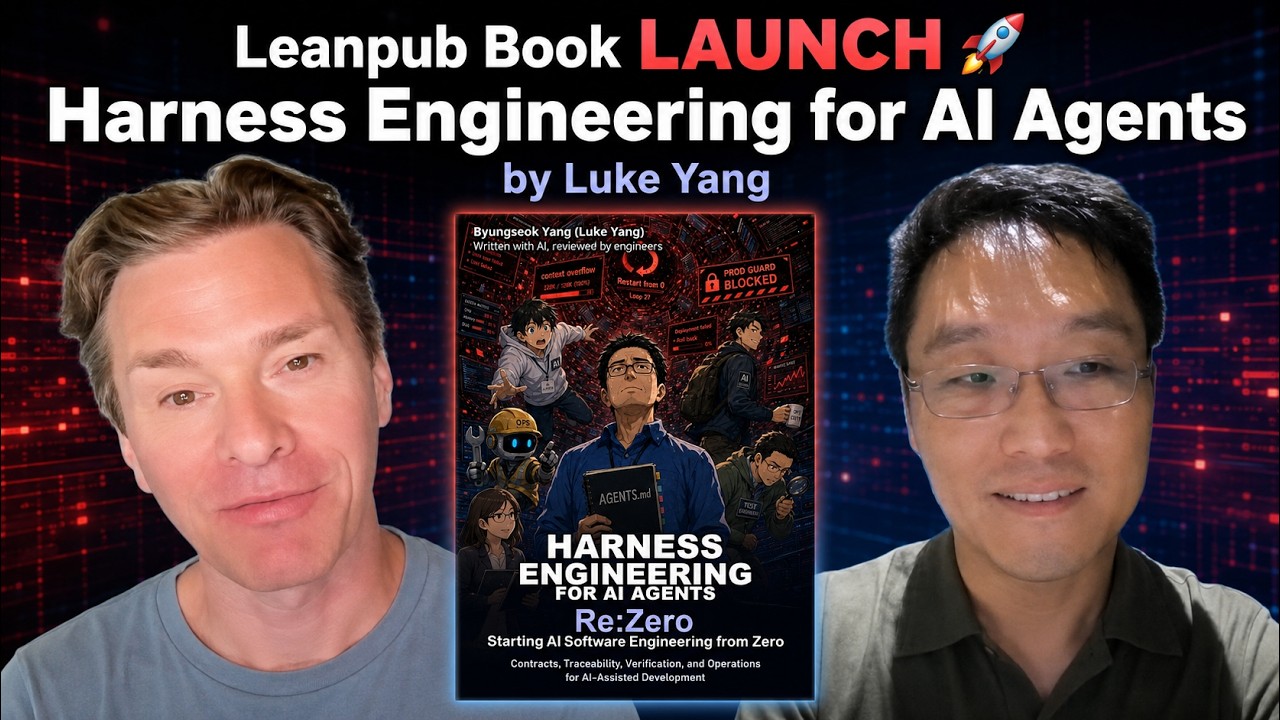
 After publishing 『Harness Engineering for AI Agents: Re:Zero』, I received an invitation to be interviewed by Leanpub co-founder Len Epp. I was hesitant because I wasn’t confident in my English, but I accepted because I saw it as an opportunity to introduce the book and Naia.
I wrote this book as an introduction to the harness engineering practices applied to Naia and as a guide to help readers get started with the Naia open-source project. Taking advantage of the ebook format, I planned to keep expanding it with insights from the actual development process. I recently followed through on that promise by publishing the Second Edition (2026.08.03). I also updated the Korean edition on WikiDocs.
While preparing for the English interview, I used AI to organize potential questions and refine my answers. This also helped me bring my thoughts about Naia and the kind of AI I want to build into a coherent narrative. The actual interview was brief and focused on two key questions, but my preparation document contained much more than I was able to say on the show. So I decided to publish the complete interview preparation script and, using technologies employed in Naia, turn it into an English-language AI mock interview video as well. I sent the video to Len in advance and received his approval to publish it.
The lip movements are a little awkward in places, but I chose to share the process and results as they are instead of spending more time polishing them. I hope this offers a small but useful example of how AI can help someone prepare for an interview in English.
1. The Actual Leanpub Launch Interview
This is my actual interview with Leanpub co-founder Len Epp. The video begins where the two key questions start.
2. An English Mock Interview Based on the Complete Preparation Script
This is not a recording or transcript of the actual call. It is an AI-generated reenactment that transforms the complete preparation document I wrote before the interview into an English conversation.
Epilogue: The Naia Story I Didn’t Get to Tell in the Book
A Model Alone Cannot Easily Become “My AI”
Much of the conversation around AI focuses on model performance. But the kind of AI I want to build cannot be explained by a model alone. It must be able to remember the user, understand the context of the current task, use the necessary tools, operate within authorized boundaries, and verify its results.
By “my AI,” I do not simply mean an AI that is good at talking with me. I mean something closer to an AI whose memory, records, settings, personality, and working context are under the user’s control. I want to build an AI that can continue working alongside its user by their choice, rather than one confined to brief conversations inside another company’s service.
Smaller Models Need More Clearly Defined Jobs
I do not want to hide the limitations of small or local models. Models clearly differ in capability, and building a good structure around a model does not make every small model equivalent to a large one.
However, when a small model is given clearer context and appropriate tools, assigned a narrow and well-defined scope of responsibility, and subjected to stronger verification, it can handle specific tasks much more reliably. Writing the book and building Naia have reinforced my belief that these surrounding development and verification systems become even more important as models get smaller.
Being Local-First Does Not Mean Rejecting the Cloud
Naia is a local-first project. That does not mean we should avoid cloud AI or AI from large technology companies. We should be able to use good models and services whenever they are needed.
What matters to me is user choice. Information that is personally important—such as memories, records, settings, and working context—should remain under the user’s control whenever possible. The AI should also work in environments without an internet connection or where data cannot be sent to external services. “Local” is less a product slogan than a direction for protecting user control.
Naia Is More Than a Chatbot with an Avatar
Naia is a local-first visual AI agent and workspace. The on-screen character can serve as an approachable entry point to Naia, but the long-term goal is not merely to build a chatbot with an avatar.
I want to build an AI that remembers the user, uses tools, and works alongside them while leaving important data and decisions under their control. By making that process open source, I also want people to do more than consume a finished product: I want them to understand it, modify it, and try building their own AI.
The Argument This Book Makes
The argument of 『Harness Engineering for AI Agents: Re:Zero』 is not about how much code AI can produce or how quickly it can produce it. It begins with the idea that AI can only be entrusted with real software development when people can understand, review, and test its work and trace where things went wrong when problems arise.
I called this harness engineering because it means designing the context, tools, scope of work, permissions, tests, and review procedures around the model as a unified system. I do not claim that the book offers a universal answer for every project. It is closer to a field report documenting what worked and what failed while rebuilding Naia with AI, along with the rules and verification methods that proved necessary.
Because Naia is open source, I hope the book will not remain a static manual published once and then forgotten, but will become a living textbook that evolves alongside the source code. When a new problem appears in the source, I revise the explanation in the book. The principles described in the book are then tested again through real development work.
While the book primarily explains this development method, the interview preparation document adds context about why I am building Naia and what kind of AI I want to create. That is the main reason I included the complete preparation document in the epilogue. The book is openly available and can be read online without purchasing it.
How I Prepared for an English Interview with AI
In this preparation process, I did not use AI merely as a tool to write English answers for me. I used it throughout the entire process: researching the interview, reducing my thoughts to short sentences, asking about expressions I did not understand, and practicing aloud.
1. First, I Used AI to Research the Interview’s Format and Scope
The first material I gave the AI was the interview invitation email I received from Len. I researched Leanpub’s official guidance and recent interview examples to determine the likely duration, format, and range of questions. Establishing what I actually needed to prepare helped me avoid generating an endless list of hypothetical questions.
2. AI Summarization: Reducing What I Had to Say to Three Sentences
Rather than creating a large number of questions and answers, I needed a few core ideas I could return to regardless of what I was asked. These were the three sentences I prepared:
- A model alone is not an agent. An agent needs a harness around the model. A model alone does not make an agent. It needs a surrounding development and verification system.
- Harness engineering becomes even more important when we use smaller or local models. The development and verification system around a model becomes even more important when using smaller or local models.
- Naia is open source, and the book will evolve as a living textbook for its source code. Naia is open source, and the book will continue evolving as a living textbook for its source code.
Even if the actual questions differed from what I expected, I planned to return to one of these three sentences.
3. Writing the English Sentences Alongside Their Korean Meaning Helped Me Learn
I did not simply memorize the English answers generated by AI. For expressions I found difficult, I asked about their meaning and why they were used, sentence by sentence. When something did not reflect what I meant, I revised it. Under each answer, I also wrote the Korean meaning and the key words I wanted to remember.
Understanding what I wanted to say proved more useful during the actual interview than memorizing the exact English sentences. Even when I could not recall a sentence precisely, I could restate the idea I understood in simpler English.
4. I Used the AI Behind Naia to Generate Separate Voices for the Interviewer and Interviewee, Then Listened Repeatedly
I printed the completed document as a PDF to review the overall flow. I then asked AI to create an English audio file with separate voices for the interviewer and interviewee. Because I already had Naia’s development environment, I could generate it and listen to it right away without purchasing a separate paid subscription. I did not have much time to study, so I listened to it repeatedly while traveling and practiced speaking the answers aloud.
Unlike reading the text alone, this helped me learn the rhythm of the conversation and how to begin answering after each question ended. In effect, I reused a single preparation document as both a PDF for reading and audio for speaking practice.
5. I Prepared Sentences for When I Missed a Question
It was more important not to panic when I failed to understand a question than to deliver every answer perfectly. I prepared sentences like these in advance:
Could you please repeat the question a little more slowly? Could you repeat the question a little more slowly?
My English is not perfect, so let me say it more simply. My English is not perfect, so I will explain it more simply.
I want to be careful because I do not want to overclaim. I want to answer carefully because I do not want to exaggerate.
On the day of the interview, I kept the preparation document and the AI session I had been using open alongside Zoom so I could search for key words if necessary. I was very nervous, but Len asked the two key questions he had shared in advance, and I was able to answer based on the ideas I had prepared.
If you are preparing for an English interview, you can use the following framework and adapt it to your own topic:
- Three essential sentences you want to communicate
- Likely questions and English answers
- The Korean meaning of each answer
- Key words to remember instead of complete sentences
- Likely follow-up questions
- Sentences to use when you miss a question
Why I Turned the Preparation Document into an AI Video
After the actual interview ended, I still had a long preparation document. I wanted to share the Naia story contained in it. The complete text could be read as an article, but I thought it might be easier to follow as a conversation, so I reworked it into a remote-interview-style video.
This time, I used Naia’s technology to create Korean audio based on the English practice audio, then produced English and Korean versions using AI-generated images and motion together with open-source lip-sync technology. At first, using the frame where speech began caused facial distortion. I fixed this by selecting a separate neutral frame in which the eyes and mouth looked stable and generating the video one sentence at a time. Codex completed this work using technology from the Naia project.
This process was somewhat different from generating a video with a single prompt.
Interview research → core message organization → anticipated Korean-English Q&A → PDF review → voice practice → mock interview video
The output of each stage became material for the next. The document prepared for the English interview became practice audio, then an article and video that could be shared publicly. I believe this is one example of how material created with AI for real work can be reused and carried forward into subsequent tasks instead of being discarded.
More important than producing the video, however, was the process of understanding and revising the content myself. AI can generate a draft quickly, but it will not automatically identify and correct everything that differs from what I actually think. I asked questions, developed my understanding, revised the material, and—with AI’s help—communicated with Len to confirm what could be published.
Closing Thoughts
What I wanted to share through this article was not simply the fact that I created an interview video with AI. I wanted to offer a practical account of how AI can help when an English interview feels daunting: organizing likely questions, reducing what you must say to a few essential points, and preparing through repeated audio practice.
That is also why I am publishing the complete interview preparation document. I could say only a little during the actual interview, but preparing for it allowed me to organize my thoughts about the Naia I want to build and what “my AI” means to me in a much fuller narrative. The video is simply a format designed to make that story easier to follow.
I hope this process offers a useful reference for anyone preparing for an English interview and helps anyone interested in Naia understand why I am building this project. I will continue improving both the book and Naia based on lessons verified through the actual development process.
