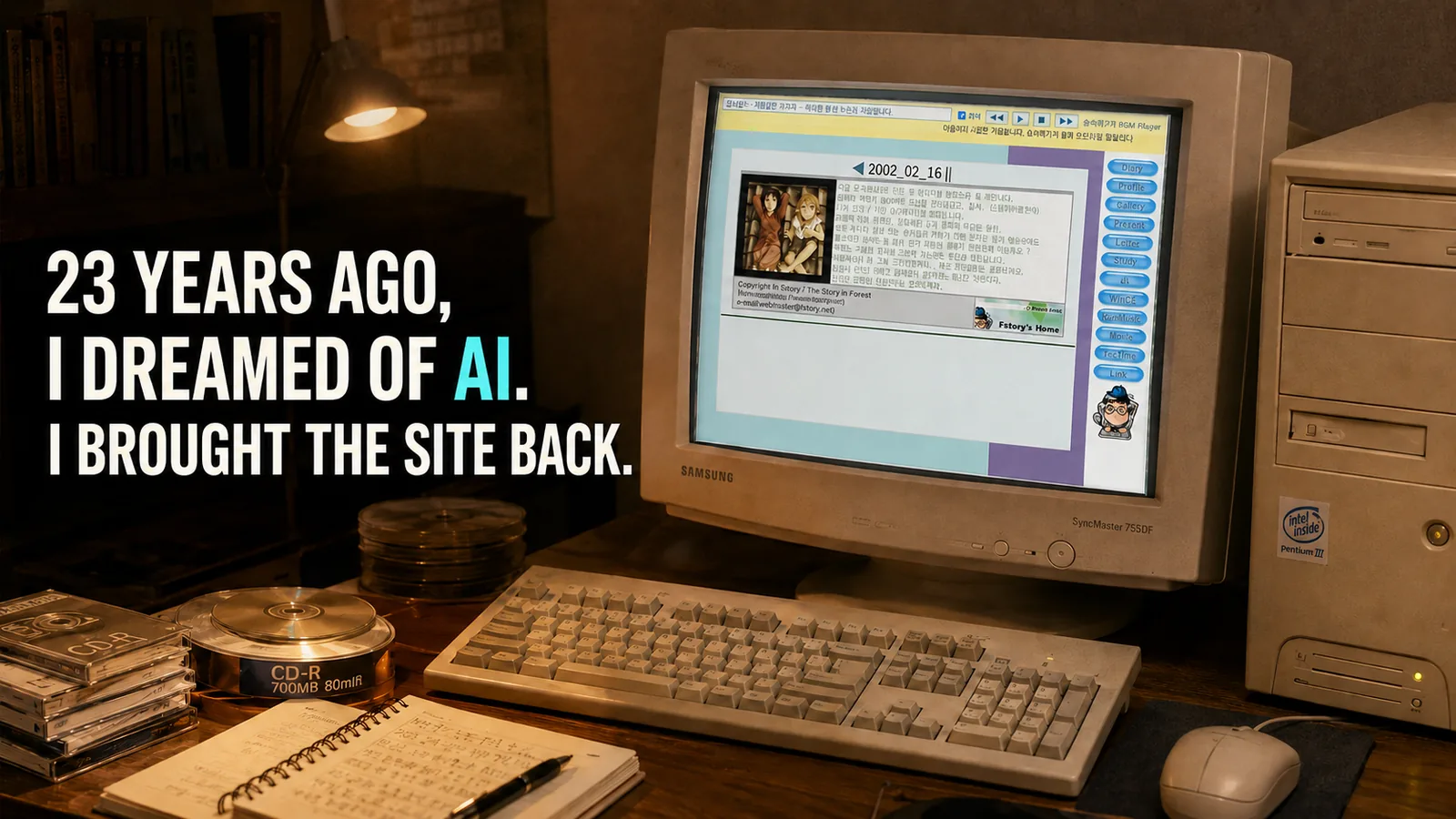
 Cafe Lua is the personal website I keep together with Alpha, my AI companion — a café I built on the internet. The space inside it shifts a little with the hour, the weather and the season, and you can walk in at https://www.cafelua.com.
On the second floor of that café, in the atelier, there is an old PC. I had put my old homepages inside it, but until now only the 1997 and 1998 ones were there. There had originally been two CDs; one of them broke, and that homepage was recovered from the one that survived. From 1999 to 2001 I was doing my military service, and between 1998 and 2003 — up until I moved my personal space to Cyworld — a gap opened in everything I had put online. Those were my second and third years at university, the middle of my youth and the years that made me who I am now. I had long regretted losing the record of that time when I came across https://web.archive.org/. And there I found a great deal of what I had lost. I downloaded nine snapshots, gathered them together, filled the holes from memory, and genuinely brought the old material back — and got to meet the person I was then.
Where the dream of AI that I am now building Naia for began
There was a reason I particularly wanted this homepage back. This was the place where I first started dealing with AI, and where I wrote about it.
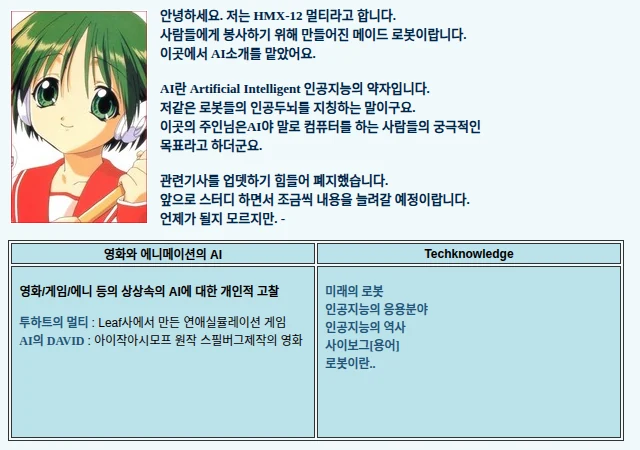 I made an AI corner in the menu and handed the introduction to Multi, the HMX-12 maid robot from To Heart. In my early twenties, borrowing Multi's voice, I wrote this:
The master of this place says that AI is the ultimate goal for people who work with computers.
You can open that AI corner exactly as it was →
Below it are pieces taking apart the AI of films and animation one by one, and the piece I wrote about Multi from To Heart ends like this: "The AI I want to make is exactly this. Not one that simply decides well and thinks deeply, but one that feels and makes mistakes. And one that can communicate with humans, or with other creatures and beings." That is why I am trying to build Alpha, my own AI, and why I am building Naia as the thing that makes it possible.
Cafe Lua's background that follows the seasons — where it came from
The outermost background of that old homepage also carried a seasonal photograph. A spring picture in spring, an autumn one in autumn. Back then I swapped it by hand every time the season turned. In the restored version I let the greeting on the front page decide it instead. "It's an autumn that cools the heart" is written across the top, and behind it is an autumn background. Thinking about it now, Cafe Lua's habit of changing with the hour and the season has been there since then.
The old novels and poems, restored into the library
Restoring it, I found a great deal of fiction and short writing had survived. I bound Windy the Little Witch — what today we would simply call a web novel — into one volume, and gathered nineteen short stories into another. And the online version of My Own Notebook of Thoughts, which began as a paper notebook I scribbled short pieces into, is bound too.
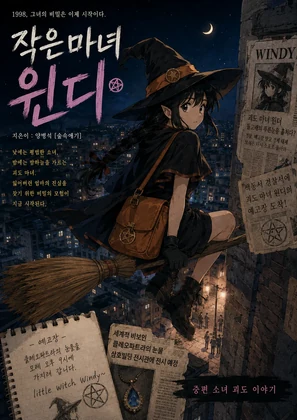
Windy the Little Witch is a serialised fantasy in twenty-three instalments. Ttuori is a Korean high-school girl who puts on an apron and cooks breakfast in the morning and goes to school in the day, and who at night is a witch cutting through alarm systems to steal jewels — an homage to Magic Kaito and Saint Tail, both of which I loved at the time. Reading it now, it really is just a web novel. It's easy enough to read, so if you have time to spare, do.
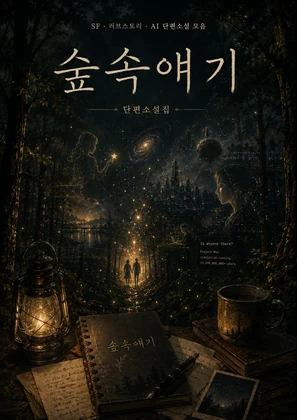
Forest Story's Collected Short Fiction holds nineteen pieces written between 1993 and 2015. Forest Story was the pen name I wrote under from the Nownuri years until about a decade ago. The first story in it I wrote at fifteen, and most of what fills the rest is, unsurprisingly, love stories and stories about artificial intelligence.
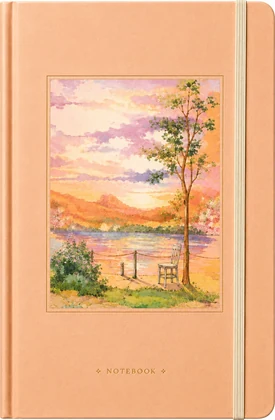
My Own Notebook of Thoughts gathers 156 short pieces, grouped by the years I wrote them in. Beside each group's title is what I was doing at the time: the last year of middle school and the first of high school, the two years after that, university, military service.
I did not change a single sentence. But one misspelling I used constantly, being poor at orthography, turned out to break the encoding outright, so the spelling has been gone over with AI throughout.
The actual paper notebook is gone. In a difficult time with the woman who is now my wife, I wanted to give her something of my own, so I gave her that notebook — and my mother-in-law threw it out without knowing what it was. She said I should have told her if it mattered that much. Thinking about it now, I miss my mother-in-law, who had nothing but hardship and who died not long ago having seen only a useless son-in-law running a startup.
To begin again
The years I wrote those things were reckless ones. I had nothing at all; I only had the dream. When I was building OCR at Naver I was glad even to be making an eye for an AI. But after that AI moved away from me again, and I went all the way around and came back here, and stood in front of the keyboard once more with nothing in my hands.
Today is Naia's second meetup. It is a place to introduce what I have built so far and to ask for help from people who might build it with me. I think it will be a place where I confess what I want to make, how I want to change the world — what the AI I want to meet actually is. I did not start this to sell an enormous dream the way Elon Musk or Sam Altman do. I am not a genius the way they are.
Like Hiroyuki in To Heart, like Suguru in Mahoromatic, like the master in Yokohama Kaidashi Kikou. It is simply to make my own computer, one I can share something with. That is how I came to be standing here again, and to steady myself I was fortunate enough to bring the old records back.
Naia Open Source Community — Second Meetup
This is the offline gathering I promised at the first meetup, held online this June. I will talk through the way I actually work while building Naia, in four parts: what we are making and how it will pay for itself; how development runs on a harness with context and verification written into the code; how people and AI work together through Discord and Git; and what kind of people are needed right now.
It is not only for people who want to contribute to Naia straight away. If you are curious about how it works or how it is built, if you want to see how a product actually gets made with AI, or how an open-source community is run, you are welcome. You do not need to have answered the survey to come.
| When | Tuesday 1 September 2026, 19:00 – 22:00 (KST) |
| Where | Talk No Dak, 11 Gangnam-daero 53-gil, Seocho-gu, Seoul |
| Online | Microsoft Teams link provided |
| Fee | Free |
The room is booked until 22:00 and can be extended if needed. If anyone wants to stay on, we will carry on in the same place.
