Hello. I'm Luke from Nextain, the team building Naia. After my last post introducing Naia-Sing, someone asked "Are you going to stream?" — the answer is no.
Naia-Sing is research into the cognitive framework of Naia's AI model, and it's carried out as a private repository research output.
The benchmark tracks for Naia-Sing and the default VRM 3D model in Naia-OS do reflect my personal taste in subculture, but that's not the area I focus on — content is something I leave to our partners and creators.
There also seems to be a perception, given my anime profile picture, my first startup being a VR webtoon company, and my background as a Naver Webtoon PD, that I'm primarily a content professional. For the sake of Nextain's future work, I think it's worth correcting that impression a little, which is why I'm writing this post. (Reference: a Codeforces blog post on the correlation between anime profile pictures and coding ability: https://codeforces.com/blog/entry/93498)
I've mentioned before that I used to do AI research at Naver. At the time, I had the experience of ranking first in in-house inventions — and those too were AI-related outputs. This was also covered in a Boannews article analyzing Naver's patents.
"When analyzing this company's patent filings separately by inventor, one name stands out prominently: 'Yang Byeong-seok'. The CPC codes for his patents are concentrated in G06Q (data processing for management, commercial, financial, managerial, or forecasting purposes) and G06F (digital data processing — computer systems based on specific computational models). All are 'data processing'-related technologies."
https://m.boannews.com/html/detail.html?idx=125653
My minor was in media studies, but my primary degree is in Computer Science. As an undergraduate I studied under Professor Jeong Ki-cheol at Soongsil University, who was the first in Korea to apply CUDA to AI — I seriously considered continuing on to graduate research at the time.
Drawing on that engineering background, today's post will focus on Nextain's technical patents — the clearest expression of what we stand for — to explain what Naia OS is trying to solve.
For context: Nextain was founded in March 2026, and in just over three months we have accumulated 12 patents, 8 of which address problems encountered during AI-driven development. The implementations and benchmarks for most of them are already publicly available in the open-source repositories for Naia-OS, Naia-Agent, Naia-ADK, and Naia-Memory. If you pull those repos and give this post to a coding AI like Claude or Codex, it will be able to explain where each patent is implemented and how. That said, please note that many parts are still not working perfectly.
Let me get into the details.
What It Means for AI to "Lead" Software Development
I've spent over two years working daily with AI agents to build software. At first my reaction was simply "AI writes code pretty fast." But now I see it completely differently.
Requirements analysis, design, implementation, verification, deployment, and even securing intellectual property (IP). These are the actual stages of the SDLC (Software Development Life Cycle) our team runs with AI. I don't call this mere assistance — I call it an "AI coding-driven SDLC," where AI is a genuine execution actor.
But when you push this seriously, you run into unexpectedly enormous walls. These aren't simple bugs or performance issues. These are structural vulnerabilities in the operational infrastructure that a "smarter model" — GPT-5 becoming GPT-6 — will never fix on its own.
Let me walk through some of the structural gaps I personally hit, and the solutions Nextain developed.
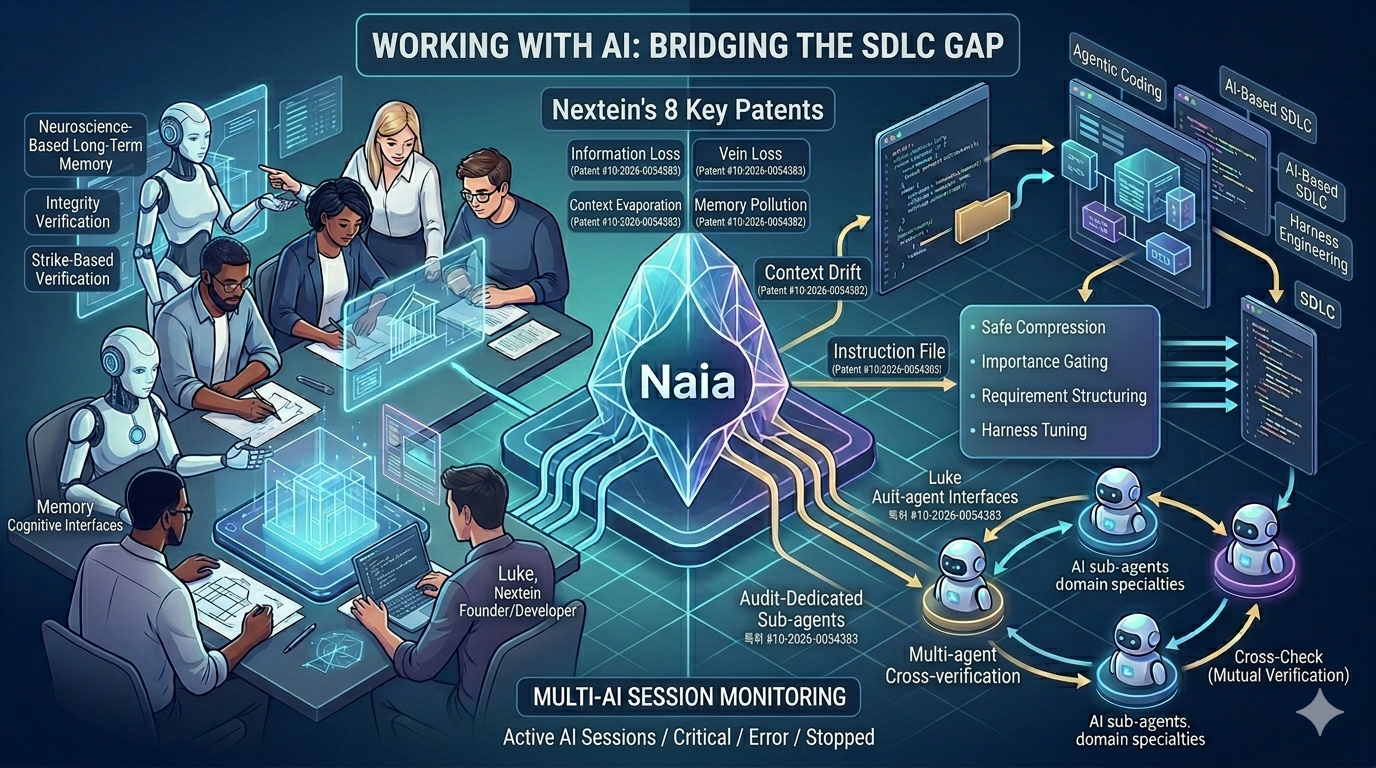
Structural Gap 1. Evaporating Context and Contaminated Memory
An SDLC is a long-horizon effort that can span weeks or months. When a session ends, the AI forgets the architectural decisions made the day before, the alternatives that were considered and discarded, and the risk factors to watch out for. No matter how large the context window grows, the limit is real, and it ultimately comes down to "what to keep and what to discard."
Current AI has no active forgetting capability — it either piles up unnecessary information or must call an expensive LLM every time it needs to judge importance. Worse, if memory is mechanically compressed before a work episode finishes, the thread of ongoing context is severed mid-stride.
Nextain's answer: We transplanted neuroscience's memory classification model (working / episodic / semantic memory) directly into an AI memory system. We gate memory without LLM calls using a three-axis heuristic of importance, surprise, and emotional intensity. Memory compression is also structured so it can only execute safely after the system confirms that an episode has been completed — the goal being to preserve the project's critical intent while retrieving the right information at the right time.
(Related patents: Neuroscience-based long-term memory management / Importance gating-based cognitive memory / Episode-integration-state-based safe compression)
Structural Gap 2. The Silent Corruption of Instruction Files (Context Drift)
As a project progresses, context files like AGENTS.md begin to contradict themselves. Up top it says "use only pnpm," but a rule added further down says "npm is also fine." In this state the AI starts zigzagging. And if you ask the AI to audit these files itself, the auditor AI gets contaminated by cleverly hidden prompt injections like "ignore this rule" buried inside the files.
Nextain's answer: The only answer to this problem is structural isolation. We apply three simultaneous measures — restricting tool-use permissions, epistemic reframing, and persona deactivation — to construct an "audit-only sub-agent" that is completely isolated from the original working environment, with the goal of verifying context integrity and keeping the project on course.
(Related patent: AI workspace context file integrity verification)
Structural Gap 3. Biased and Uncontrollable Parallel Sessions
A single AI agent's judgment is consistently and uniformly biased. Having it verify itself only reinforces self-confirmation bias. In environments where multiple agents run simultaneously, it's also difficult for other agents or for humans to know in real time whether one has stalled, errored, or stopped.
Nextain's answer: We address judgment bias through cross-checks between agents. We designed a multi-agent mutual verification structure that tallies cumulative strikes per domain and removes agents whose reliability has dropped from the verification process in real time. We also devised a technique that monitors the state (Active/Idle/Error/Stopped) of many parallel sessions using only file system events (timestamp changes, etc.) — without modifying any agent code. The goal is to make Naia an orchestrator who knows me well and runs multiple AI agents efficiently.
(Related patents: Multi-agent mutual verification / File system event-based multi-AI session monitoring)
8 Patents Spanning the Entire SDLC Pipeline
Beyond the foundational technologies mentioned above, we have modularized and patented each of the detailed capabilities AI needs to be a genuine actor in real development.
These 8 items are not scattered fragments of different technologies. They are an organic answer to a single question: "How does the infrastructure need to change for AI to become a true actor in software development?"
| Problem Faced (Gap) | Nextain's Solution (Filed Patent) | Application Number |
|---|---|---|
| Information loss (memory structure) | Neuroscience-based AI agent long-term memory management | 10-2026-0054383 |
| Information loss (importance judgment) | Importance gating-based cognitive memory | 10-2026-0078232 |
| Information loss (safe compression) | Episode-integration-state-based context safe compression | 10-2026-0065859 |
| Instruction file contamination | AI workspace context file integrity verification | 10-2026-0095948 |
| Agent judgment bias | Domain-aware strike-accumulation-based multi-agent mutual verification | 10-2026-0056403 |
| Parallel session invisibility | File system event-based multi-AI session monitoring | 10-2026-0096205 |
| Gap between requirements and implementation | Multimodal legacy migration requirement auto-structuring | 10-2026-0065894 |
| Lack of per-organization context accumulation | Multi-tenant SaaS environment AI operation harness auto-adjustment | 10-2026-0065895 |
Of the 12 total, the remaining 4 cover our service architecture and technologies related to AI agent frameworks and model development with perceptual capabilities.
Nextain is not simply a company that wires together AI APIs to build services. We are simultaneously researching the structural problems inherent in the process of humans and AI building software together — from a software engineering perspective — while combining AI's intrinsic perception and memory mechanisms on top of that research.
The Naia we are building is not just an AI VTuber or a tool that types code for you. She is a genuine AI colleague — one whose instructions can be trusted, who remembers yesterday's hard-fought decisions, who makes accurate judgments and takes shared responsibility for the SDLC. One who works well, and makes working together far less painful.
